

How they look good AND cut heat loss
We’ve all been there. You’re sitting in your living room on a chilly January evening, the heating is cranked up, but there’s still a suspicious chill tickling the back of your neck. Older UK homes, especially those with large bay windows or period features, are notorious for letting precious heat escape right through the glass.
As a result, we get asked one question almost every day: are shutters good for insulation? With energy bills remaining a major concern for households across Essex, finding practical ways to trap warmth inside has never been more important. People want to know if upgrading their window dressings will actually make a dent in their heating usage, or if it’s just clever marketing.
The short answer is a resounding yes. But the long answer is far more interesting. How you use your louvres, the style you choose, and most importantly, how well they are fitted, will dictate just how cosy your living space becomes. As a local, family-run business based in Chelmsford, we’ve spent years transforming draughty rooms into comfortable spaces. Let’s look at exactly how this works, and what you need to know before taking the plunge.
Are shutters good for insulation (the honest answer)
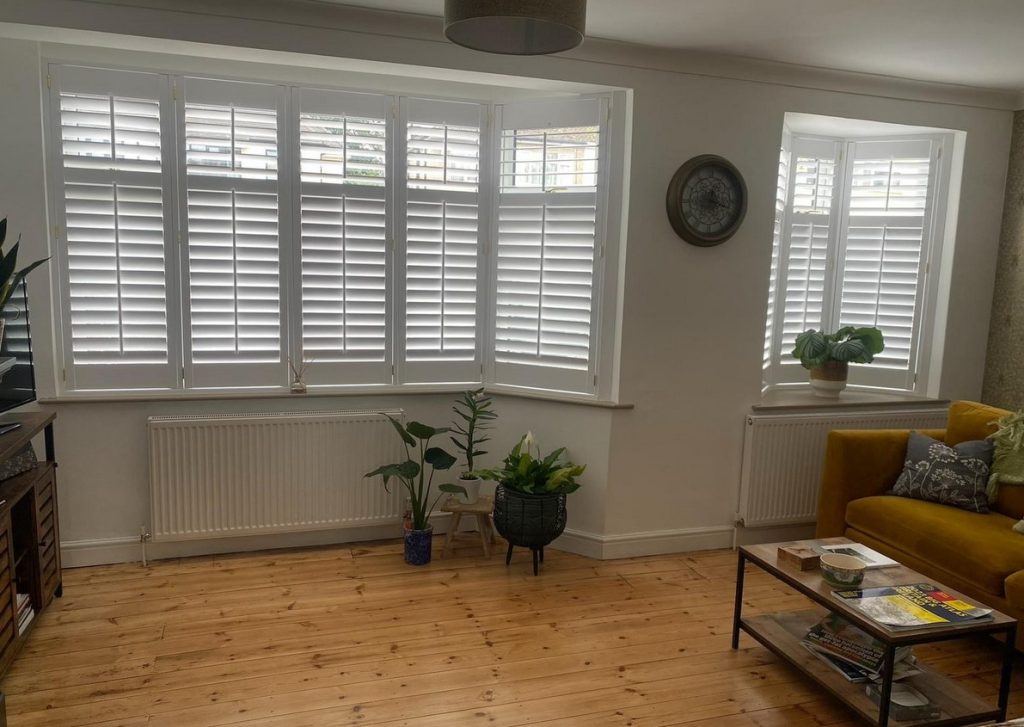
Yes, they absolutely are. Windows are typically the weakest point in your home’s thermal envelope. Even if you have modern double glazing, glass is a terrible insulator compared to a solid brick wall.
When you install high-quality window shutters, you are essentially adding a physical barrier between the cold glass and the warm air in your room. A recent independent study by the University of Salford and the British Blind and Shutter Association (BBSA) proved this brilliantly. Their testing found that internal plantation shutters can reduce heat loss through windows by up to 28%. That is a massive difference for a product that also happens to look stunning.
However, performance varies depending on the specific product and how it sits within your window recess. It’s not quite the same as replacing your glazing, but it is one of the most effective ways to upgrade your home’s thermal efficiency without knocking down walls.
How shutters reduce heat loss (what’s actually happening)
To understand the benefits, it helps to know how you are losing heat in the first place. Heat always wants to move towards the cold. In winter, the warm air in your home hits the cold window pane, cools down rapidly, and sinks to the floor, creating a continuous cycle of chilly draughts (known as convection).
Shutters disrupt this cycle in a few clever ways:
- Trapping an insulating layer of air: When the panels are closed, a pocket of still air is trapped between the shutter and the window glass. Because air is a poor conductor of heat, this gap acts as a brilliant thermal buffer.
- Significant draught reduction: When fitted perfectly flush against your window frame, they block those sneaky breezes that slip through the cracks of older windows.
- Radiant heat reflection: Lighter finishes and sturdy materials can help reflect some ambient heat back into the room rather than letting it seep outside.
Insulated shutters vs standard shutters (what to look for)
If you have been doing your research, you might have come across the term insulated shutters. In the real world, “insulation” in this context is mostly about reducing air movement and creating a tight seal.
True energy efficiency comes from the build quality of the frames and the density of the material. Solid panel shutters, for instance, offer maximum thermal performance because there are no louvres for air to slip through. However, the trade-off is that you lose the flexible light control that makes louvred plantation shutters so popular.
For most homes, standard high-quality plantation shutters provide the perfect middle ground. They offer excellent draught reduction while still allowing you to tilt the slats for privacy and daylight.
Which shutter styles are best for keeping warmth in?
Not all designs perform exactly the same when it comes to trapping heat. If a cosy home is your main priority, the style you choose makes a difference.
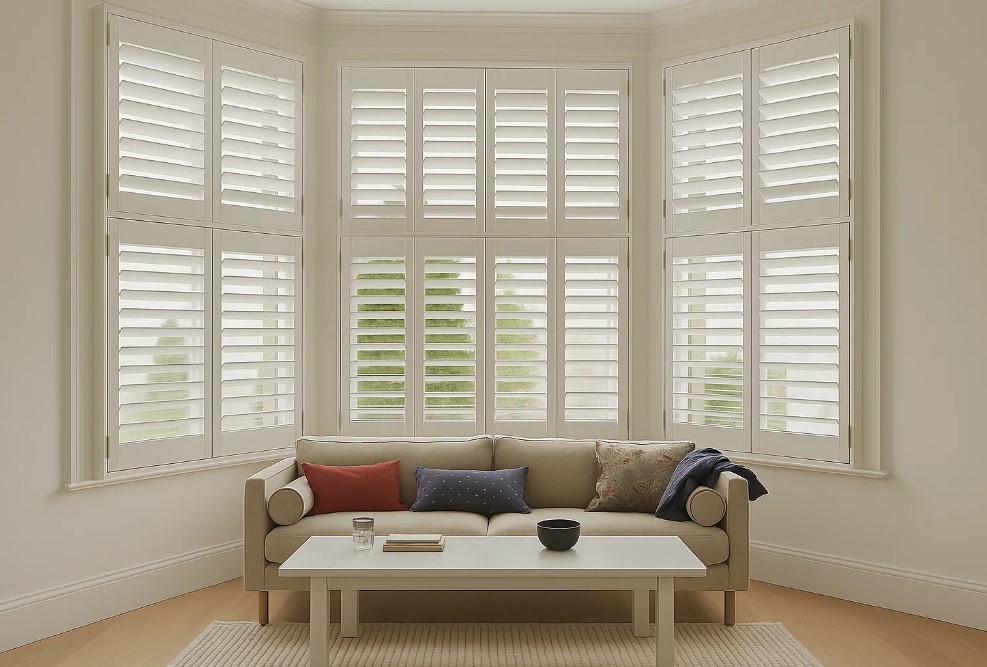
- Full height shutters: These are the undisputed champions for winter comfort. Because they cover the entire window from top to bottom, they create a complete barrier against draughts.
- Tier-on-tier shutters: These offer fantastic flexibility. You can keep the bottom panels closed to block out the cold and stop passers-by peering in, whilst throwing the top panels open to let the winter sun warm the room.
- Café style shutters: These only cover the lower half of the window. While they look incredibly chic and are brilliant for privacy, they obviously leave the top half of the glass exposed, meaning they are less effective at preventing heat loss.
Material matters (but fitting matters more)
You can buy the thickest, highest-quality materials on the market, but if they aren’t fitted properly, the cold air will simply bypass them.
The secret to a truly warm room lies in the installation. An accurate survey and meticulous measurement are non-negotiable. If there are gaps around the frame, you lose the insulating air pocket.
This is why we are so passionate about our process. All of our installers at Lifestyle Shutters & Blinds are fully trained carpenters. We never use subcontractors. We take the time to ensure your frames, hinges, and panels sit beautifully. If your period windows are slightly wonky (as most are!), we use colour-coordinated trims and extend window nosing to ensure everything fits snugly and looks completely natural.
Energy saving shutters UK: tips for getting the best results at home
Investing in energy saving shutters UK homeowners love is only step one. How you use them dictates how much warmth you actually retain. Here are a few practical habits to adopt:
- Close them at dusk: As soon as the sun goes down and the temperature drops, shut the panels and close the louvres flat. This traps the heat you’ve generated during the day.
- Embrace the sun: On crisp, sunny winter mornings, open the louvres (or the panels entirely) to let the free solar heat warm up your living space.
- Layer up: If you have particularly leaky, single-glazed windows in an old property, there is no harm in pairing shutters with a set of thick curtains for an ultimate thermal barrier.
- Manage ventilation: While a tight seal is great for warmth, older homes need to breathe to prevent condensation. Crack the window and open the louvres for ten minutes in the morning to let fresh air circulate, especially in bedrooms and kitchens.
Bonus: shutters can help in summer too
It’s worth noting that the insulation properties work both ways. When the July heatwaves hit, large expanses of glass act like a greenhouse, turning south-facing rooms into saunas. By angling your louvres upwards, you can bounce the harsh, direct sunlight back out the window while still allowing a cool breeze to flow through the room. It’s year-round comfort without relying on fans or air conditioning.
Frequently asked questions
Are shutters good for insulation in older UK homes?
Yes. Older homes often suffer from single glazing or poorly sealed frames. Adding a tightly fitted internal shutter creates a brilliant secondary barrier that drastically cuts down on cold draughts.
Do plantation shutters help with draughts?
Absolutely. Because they are fixed directly to the window frame or recess, they provide a much sturdier, flush barrier than free-hanging curtains or standard blinds, making them highly effective at blocking draughts.
Are insulated shutters worth it compared with thicker curtains?
While heavy, thermal-lined curtains are great, they often leave gaps at the top, bottom, and sides where cold air can escape. Shutters offer a more precise seal, are easier to keep clean, and give you much better control over natural light.
Will shutters stop condensation on windows?
They won’t cure the root cause of condensation (which is excess moisture in the air hitting cold glass). However, by keeping the room warmer, they can help. Just remember to ventilate the room daily by opening the louvres and a window to let the damp air escape.
Which shutters are best for bay windows and large windows?
Full height, made-to-measure shutters are ideal for bay windows. Our carpenters can custom-fit the frames to follow the exact curve or angle of the bay, ensuring maximum heat retention and a flawless finish.
Can I still let light in and keep heat in?
Yes! That’s the beauty of louvres. You can keep the main panels shut to maintain the physical barrier, but tilt the slats slightly to let daylight filter through without creating a massive draft.
How long does it take to get shutters fitted?
Lead times can vary depending on the product, but we do offer ranges that can be fitted in just two weeks. It’s always best to ask us during your survey for the most accurate timeline.
Do you offer a free survey and quote in Essex?
We certainly do. We offer a completely free, no-obligation design and survey appointment across Essex, as well as surrounding areas in Kent and London.
Ready to warm up your home?
Nobody wants to spend their winter shivering on the sofa while paying a fortune in heating bills. Upgrading your window dressings is a smart, stylish way to improve your home’s thermal efficiency.
If you are curious about how made-to-measure shutters could transform your space, we would love to help. At Lifestyle Shutters & Blinds, we take pride in offering honest advice, meticulous carpentry, and a friendly, stress-free service.
Let’s make your home feel less like a fridge by the window. Get in touch with our Chelmsford team today to book your free, no-obligation design and survey appointment.