
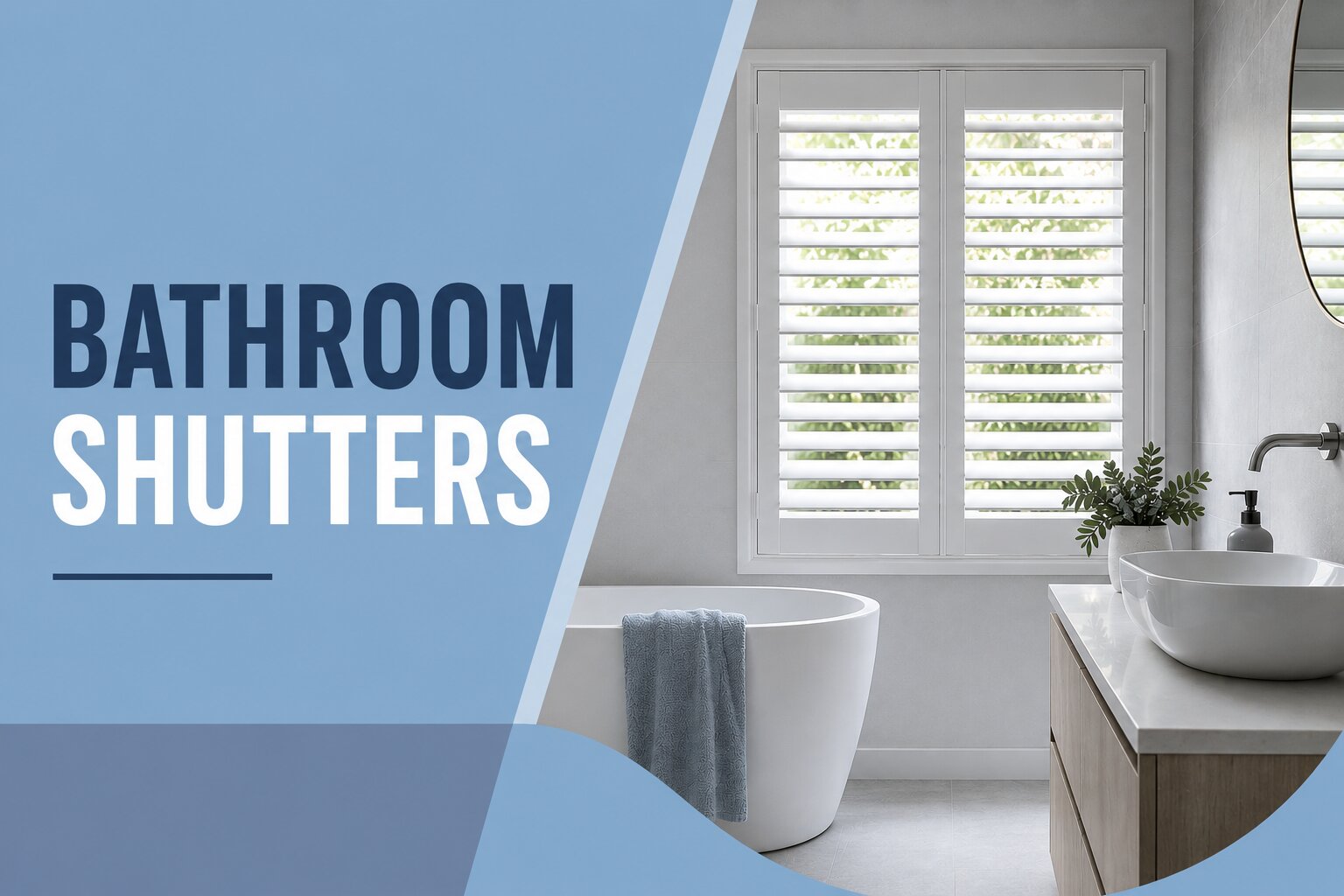

Quick answer: Moisture-resistant shutters — typically made from faux wood, PVC or vinyl — are the best window covering choice for bathrooms, wet rooms and ensuites. They resist warping, mould and peeling in humid spaces, offer excellent privacy and light control, and are far easier to maintain than fabric blinds or curtains.
Bathrooms are, let’s be honest, brutal on window coverings. Every hot shower sends a wave of steam rolling across the room. Condensation drips down frames. Cleaning products get splashed everywhere. And if your window is anywhere near a bath or shower, it’s taking a daily soaking.
Most standard blinds and curtains simply weren’t built for this. Fabric that covers the entire window goes mouldy. Real wooden shutters warp. Metal mechanisms rust. And before long, you’re peeling off a blind that looks like it’s been through a car wash and wondering where you went wrong.
The good news? Bathroom shutters — specifically moisture-resistant ones — are designed to handle exactly this kind of environment. They look incredible, they’re practical, and they’ll outlast almost anything else you could put on a bathroom window.
In this guide, we’ll walk you through why bathroom shutters are such a smart choice, which materials work best (and which don’t), how to choose the right style for your space, and how to keep them looking great for years to come.
We’re Lifestyle Shutters and Blinds, a small independent family-run business based in Chelmsford. We design and install made-to-measure shutters and blinds across Essex — and we’ve seen firsthand what happens when the wrong window covering meets the wrong room.
Why bathrooms are so hard on window coverings
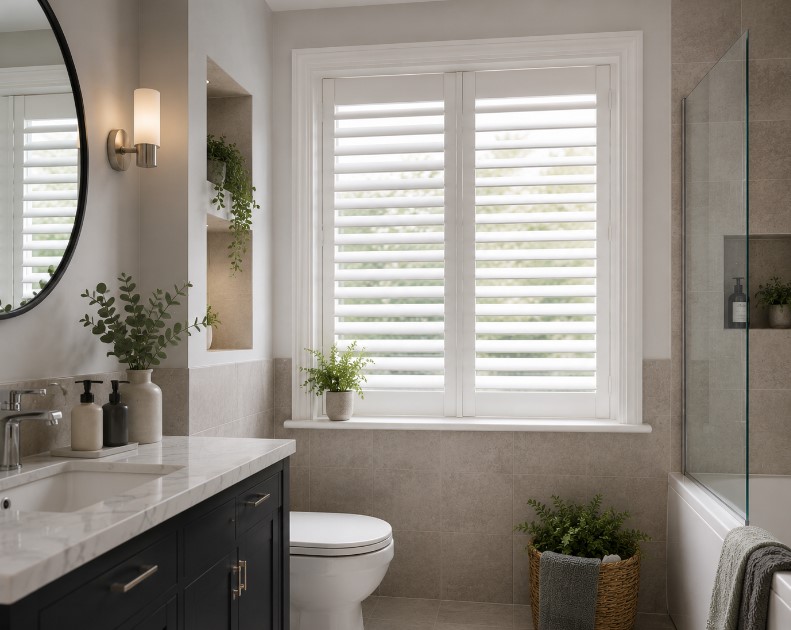
It’s not just steam. A busy bathroom goes through several cycles of heat, moisture and cold every single day. Hot showers spike humidity levels dramatically. Then the room cools. Then it happens again. Repeat, day after day, for years.
That kind of repeated expansion and contraction is what causes real wood to warp, paint to peel and fabric to develop that faint musty smell you can never quite get rid of. Add in condensation running down window frames, the occasional splash from the sink or shower, and the regular use of bleach-based cleaning sprays — and it’s a challenging environment by anyone’s standards.
Common failures we see include:
- Fabric roller blinds developing mould along the bottom edge
- Wooden slat blinds bowing or twisting out of shape
- Metal components (springs, brackets, chains) corroding and seizing up
- Roman blinds trapping moisture and becoming impossible to dry properly
The right window covering won’t just survive this environment — it’ll thrive in it.
What are moisture-resistant shutters (and what does “moisture-resistant” actually mean)?
It’s worth being clear about terminology here, because “moisture-resistant” and “fully waterproof” aren’t the same thing.
Fully waterproof materials can be submerged or saturated without taking damage. Moisture-resistant materials are engineered to handle humidity, condensation and splashing without warping, swelling or deteriorating — which is exactly what you need from a bathroom window covering.
Good moisture-resistant shutters achieve this through a combination of closed-cell materials (which don’t absorb water the way open-grain wood does), durable protective finishes, and precision engineering that keeps the panels stable even when humidity spikes. When they’re correctly fitted with appropriate frame allowances, there are very few bathroom environments they can’t handle comfortably.
Best materials for bathroom shutters
Faux wood / PVC shutters: the go-to for wet rooms and steamy bathrooms
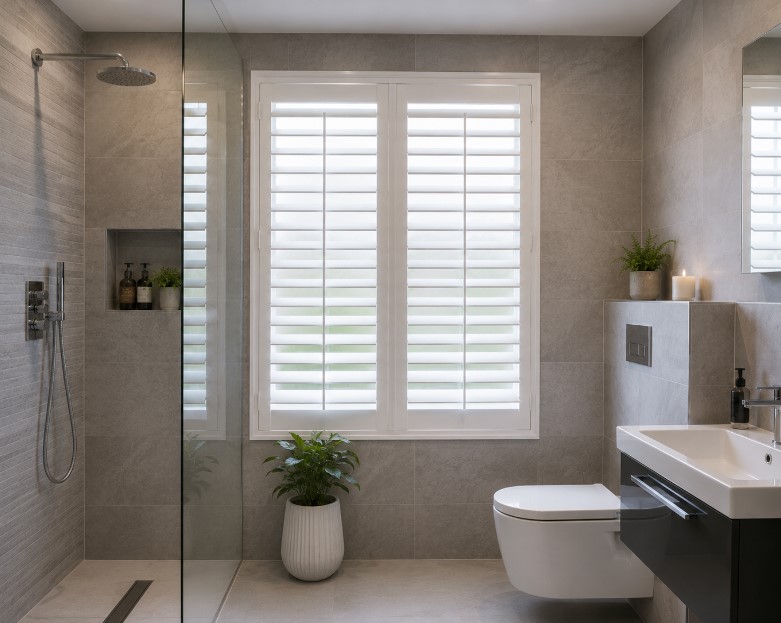
Faux wood shutters — made from PVC or engineered vinyl — are our top recommendation for most bathrooms, and especially for wet rooms and ensuites. They’re built specifically to cope with high humidity, won’t warp or crack with repeated temperature changes, and are incredibly easy to wipe down.
They also look far better than you might expect. Modern faux wood shutters have a clean, solid appearance that’s almost indistinguishable from the real thing — at least from the other side of the room. Available in a wide range of finishes and colours, they’re as much a style choice as a practical one.
Key benefits:
- Resistant to warping, swelling and cracking in humid conditions
- Easy-clean surface — a damp cloth is usually all you need
- Colour stays stable over time, even in steamy environments
- Lighter weight than hardwood, which can be handy on smaller frames
Hardwood shutters in bathrooms: when they can work
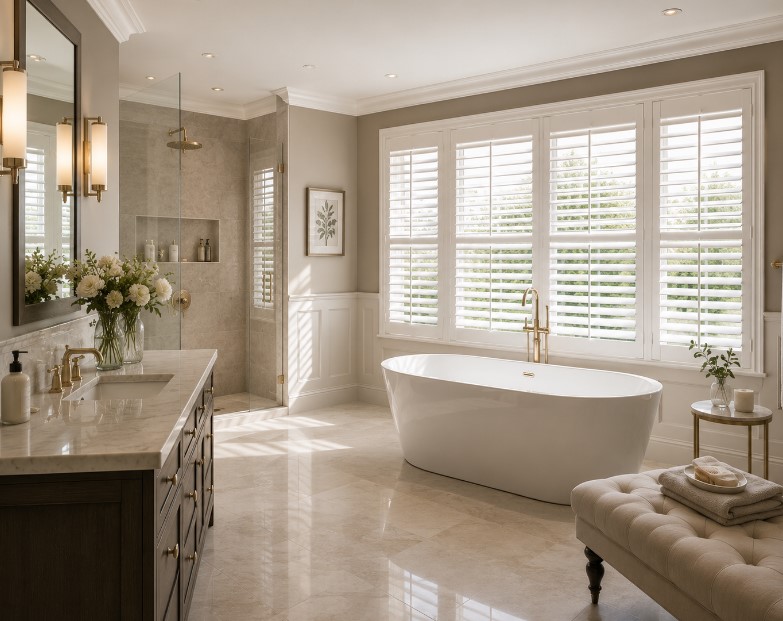
Hardwood shutters aren’t automatically off the table in bathrooms — but they do need more careful consideration. If your bathroom has decent ventilation, the window isn’t directly in a splash zone, and the shutters are properly finished with a durable paint or stain, hardwood can work beautifully.
We work with an English family-owned manufacturer based in Kent whose hardwood shutters are made from sustainable timber with high-quality durable finishes. These are a world away from cheaper imports, and when fitted properly in a lower-humidity bathroom, they perform very well.
That said, for wet rooms or heavily steamed bathrooms, faux wood is still the safer long-term choice.
What to avoid in very wet areas
Porous materials without a proper protective finish are an obvious concern, but fabric-based options deserve a mention too. Roller blinds, Roman blinds and curtains all trap moisture to varying degrees. Even “moisture-resistant” fabric blinds can develop mould along hems and folds over time, and they’re generally much harder to clean thoroughly. In a wet room or ensuite, they’re rarely a practical long-term solution.
Why bathroom shutters beat blinds and curtains in wet rooms and ensuites
Beyond material performance, shutters offer a few benefits that blinds and curtains simply can’t replicate.
Privacy without losing the light. The louvres on plantation shutters can be angled to let daylight in while keeping your bathroom private — even with the light on at night. You control exactly how much you can see in or out.
Ventilation-friendly. Tilt the louvres, crack the window, and you’ve got airflow without compromising privacy. It’s one of the easiest ways to help manage bathroom humidity.
Low maintenance. There’s no fabric to machine wash, no mechanism to oil, no slats to untangle. A quick wipe-down is usually all it takes.
A cleaner, more built-in look. Shutters sit flush within the window recess and give a neat, architectural finish that curtains and most blinds just can’t match.
Added thermal insulation. Shutters create an extra layer between the glass and the room, which helps reduce heat loss — particularly useful if your bathroom window is single-glazed or older.
Design ideas for bathroom shutters
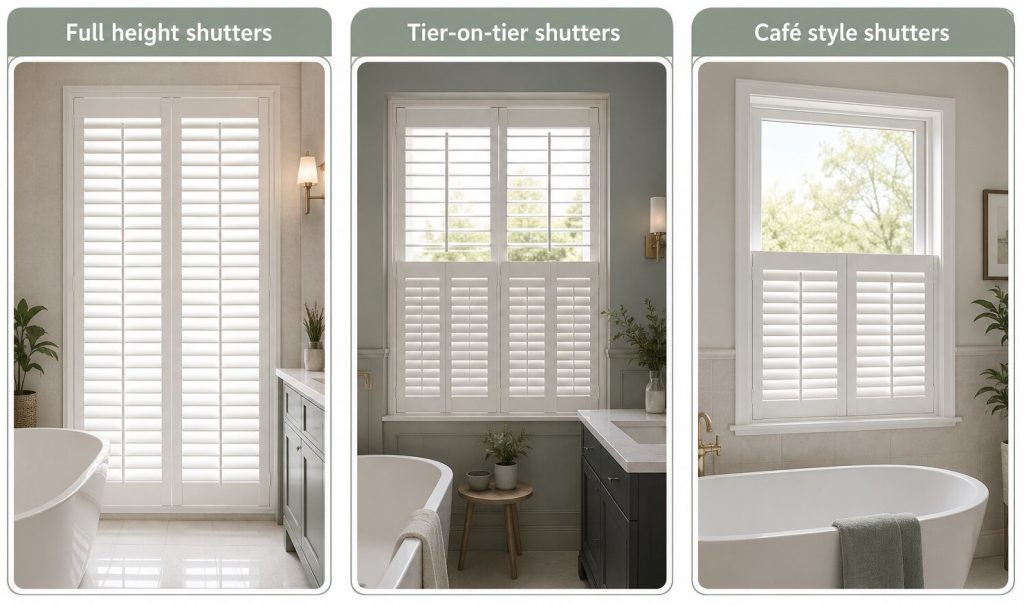
Just because a shutter needs to be practical doesn’t mean it has to be an afterthought.
Full height shutters give a clean, uninterrupted look and maximum privacy. They work particularly well in ensuites and bathrooms where the window is at mid-height.
Tier-on-tier shutters have independently opening top and bottom panels — handy if you want the top half open for daylight and ventilation while keeping the bottom half closed for privacy.
Café style shutters cover only the lower half of the window. If your bathroom is on the ground floor or looks out onto a street, café style shutters give you privacy at eye level while leaving the top open for natural light.
For colour, crisp whites and soft neutrals are timeless, but we also offer a colour matching service — including Farrow & Ball’s most popular shades — if you want something that ties into the rest of your décor.
Choosing shutters for wet rooms vs ensuites
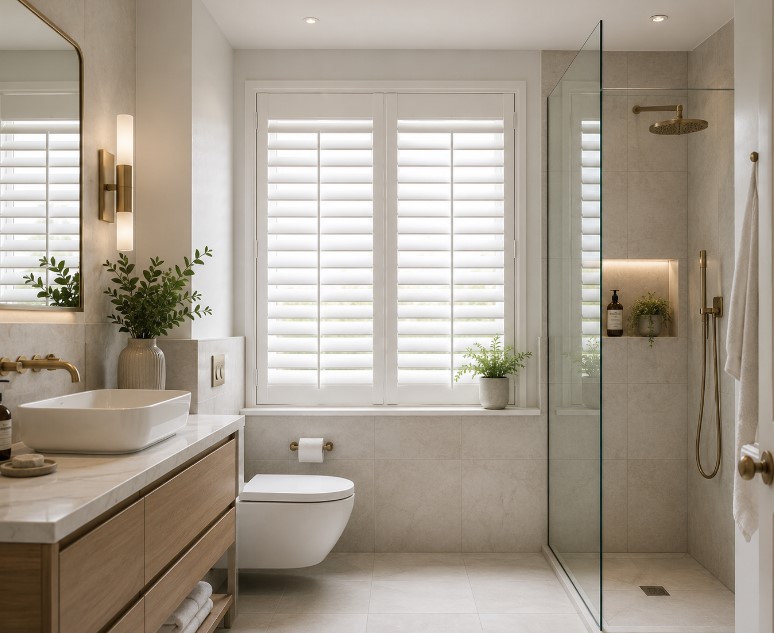
These two spaces have slightly different requirements, and it’s worth matching the solution to the room.
Shutters for wet rooms: Moisture resistance is the non-negotiable here. Faux wood or PVC shutters are almost always the right call. Consider how close the window is to the shower and whether there’s adequate ventilation — an extractor fan working properly will significantly extend the life of any window covering.
Ensuite shutters: Ensuites often have smaller windows and a slightly less aggressive humidity profile than dedicated wet rooms. You’ve got a bit more flexibility here. Tier-on-tier or full height shutters both work well, and if the ventilation is good, a properly finished hardwood shutter is also worth considering.
In both cases, the quality of the fitting matters as much as the material. Gaps, poor frame tolerances or frames that trap moisture will undermine even the best shutter.
Measuring and fitting tips
Getting the measurement right is critical in bathrooms, where frames, tile edges, handles and window hardware can all complicate a standard installation.
A few things to bear in mind:
- Window reveals and depth: Shutters fitted within the recess need precise depth measurements, especially if there are tiles running up to the frame
- Handle and hinge clearance: Make sure there’s enough clearance for the shutter panels to open fully without catching on hardware
- Frame condition: Bathroom window frames can deteriorate faster than elsewhere in the house — it’s worth checking the condition of the frame before committing to an installation
- Ventilation position: If your window trickle vent or opening mechanism is in an awkward spot, a good installer will factor this into the design
This is exactly why we offer a FREE, no obligation design and survey appointment. Getting eyes on the space before quoting means no surprises on fitting day.
How to look after moisture-resistant shutters
Maintenance is refreshingly straightforward.
- Wipe down with a damp cloth and a mild, non-abrasive cleaner — avoid anything bleach-heavy directly on the surface
- After very steamy sessions, give the louvres a quick dry to prevent water sitting on the hinges
- Check the tilt rod and hinges every so often — a gentle adjustment is all that’s usually needed if anything feels stiff
- Keep your extractor fan in good working order; good ventilation does as much for your shutters as any maintenance routine
That’s genuinely it. There’s no special treatment required.
Frequently asked questions
Are bathroom shutters a good idea if the room gets very steamy?
Yes — provided you choose the right material. Faux wood or PVC shutters are specifically designed to handle high humidity, condensation and temperature changes without warping or deteriorating. Pair them with decent ventilation and they’ll last for years.
What are the best moisture-resistant shutters for wet rooms?
Faux wood (PVC/vinyl) shutters are the best choice for wet rooms. They’re resistant to moisture, easy to clean and won’t warp in the kind of high-humidity environment a wet room produces.
Can you get plantation shutters that are also waterproof shutters and suitable for bathrooms?
Yes, you can get plantation shutters that are waterproof and ideal for bathrooms. Faux wood (PVC/vinyl) shutters are specifically designed to handle high-moisture environments. They are resistant to water damage, won’t swell or warp, and are easy to maintain, making them a perfect choice for bathrooms and other humid areas.
Can I put shutters inside a shower room or next to a bath?
You can — as long as the shutters are moisture-resistant and correctly fitted. Keep them away from direct water spray where possible, and ensure ventilation is adequate. We’ll advise on the best options during a survey.
Will ensuite shutters give me privacy at night with the light on?
Yes. The louvres can be angled to block sightlines from outside, even when your internal light is on. Full height or tier-on-tier shutters both provide good night-time privacy.
Are faux wood shutters better than real wood in bathrooms?
For most bathrooms, yes. Faux wood handles humidity better, is less prone to warping, and requires less maintenance. Real wood shutters with a durable finish can work in lower-humidity bathrooms, but faux wood is generally the safer and more practical long-term choice.
How do I clean bathroom shutters without damaging the finish?
A damp cloth with a mild cleaner is all you need. Avoid abrasive scrubbers or undiluted bleach directly on the surface. Dry the louvres after cleaning if there’s any pooling around the hinges.
Do shutters help reduce condensation on windows?
Shutters create an insulating layer between the glass and the room, which can help reduce the temperature differential that causes condensation. They won’t eliminate condensation on their own, but combined with good ventilation, they’re part of the solution.
Can you fit shutters to small or awkward bathroom windows?
Absolutely. Made-to-measure shutters can be built to fit almost any window shape or size, including narrow reveals, non-standard heights and even shaped windows. We’ll assess the specifics during a free survey.
How long does it take to get shutters measured and fitted?
Lead times vary depending on the specification, but we can typically have shutters fitted within two weeks of ordering. We’ll confirm a timeline at the time of your survey.
Do you offer a guarantee and professional installation?
Yes. We use our own fully trained installers — no subcontractors — and offer a lifetime guarantee on selected product ranges. Every installation is carried out with the same attention to detail, from initial survey through to final fitting.
Ready to upgrade your bathroom windows?
Moisture-resistant shutters are, frankly, one of the smartest investments you can make in a bathroom renovation. They look better, last longer and perform more reliably than almost any other window covering option — especially in wet rooms and ensuites where humidity is a constant factor.
If you’d like to explore what’s possible in your home, we’d love to help with all the advice you need. As a small independent family-run business based in Chelmsford, we cover the whole of Essex and surrounding areas, and we offer a completely FREE, no obligation design and survey appointment. There’s no hard sell — just honest advice, accurate measuring and a quote with no hidden extras.