

Quick answer: Yes, you can fit shutters on patio doors and large windows — and they look brilliant. The key is choosing the right style (full height, tier-on-tier, or track system) for your opening. Tracked shutters suit wide spans and sliding doors best, while hinged panels work well on French doors. A proper survey makes all the difference.
Large expanses of glass are one of the finest things about modern homes. They flood rooms with light, frame garden views, and give spaces a feel you simply can’t get from a solid wall. But they also come with a familiar set of headaches: neighbours who can see straight in after dark, summer glare that turns your sofa into a sun lounger you never asked for, and that particular chill that creeps off a wide glass panel on a January evening.
Blinds are one answer, of course — but they flap, they fade, and they rarely look as clean as you’d like. Shutters, on the other hand, hold their shape, add genuine character to a room, and — when they’re made to measure and fitted properly — feel like they were always supposed to be there.
The challenge is that big openings need a bit more thought than a standard window. A patio door you use ten times a day has different demands from a bathroom window you crack open twice a week. In this guide, we’ll walk you through everything: the styles that work best, how track system shutters change the game for wide spans, the practical considerations most people overlook, and what to expect when you book a proper survey and fitting.
Why bigger openings need a different approach
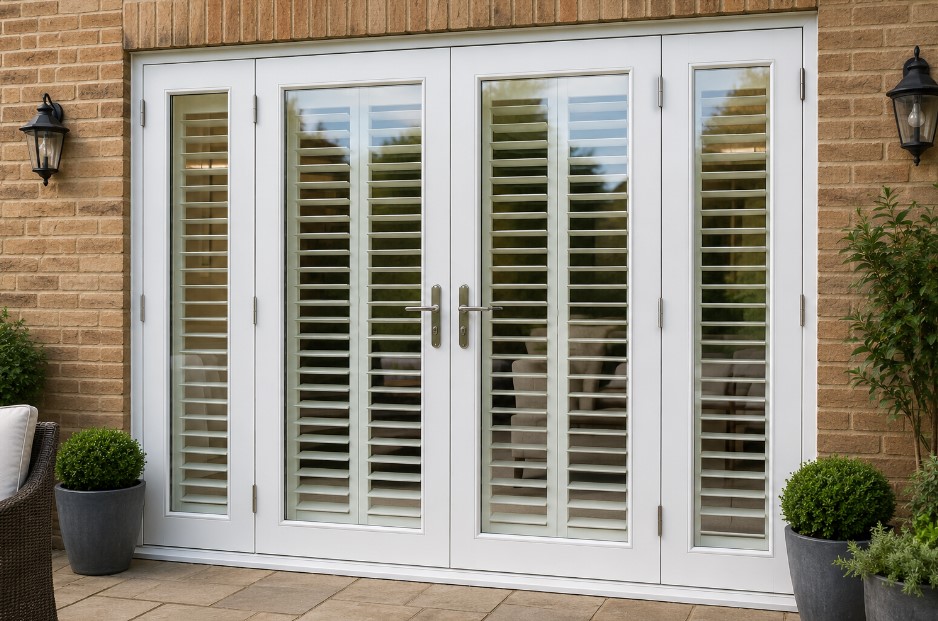
Standard plantation shutters are hinged to a frame and swing open like an internal door or cabinet. On a modest window, that works perfectly. On a 2.4m-wide sliding patio door, it becomes a problem — not because shutters can’t be fitted, but because the swing space, the clearances, and the day-to-day use all need to be thought through carefully.
There are a few things that make large openings and door shutters different from regular window applications:
- Traffic flow — you need to open and close the door freely without wrestling with panels.
- Handle and lock clearances — standard shutter frames need to account for door furniture, or you’ll be fighting the hardware every time.
- Panel weight and stability — wider spans need additional mid-rails or dividers to keep the louvres straight and the panels rigid over time.
- Stacking space — whether panels fold, slide, or stack depends entirely on the space available beside the opening.
Get these details wrong and even the most beautiful shutters become a daily irritation. Get them right — which is what a proper survey is for — and they’re an effortless part of the room.
Shutters for patio doors: what works best (and why)
There’s no single “correct” style for shutters for patio doors — the best option depends on how you use the door, the width of the opening, and the look you’re going for. Here are the main options.
Full height shutters for doors
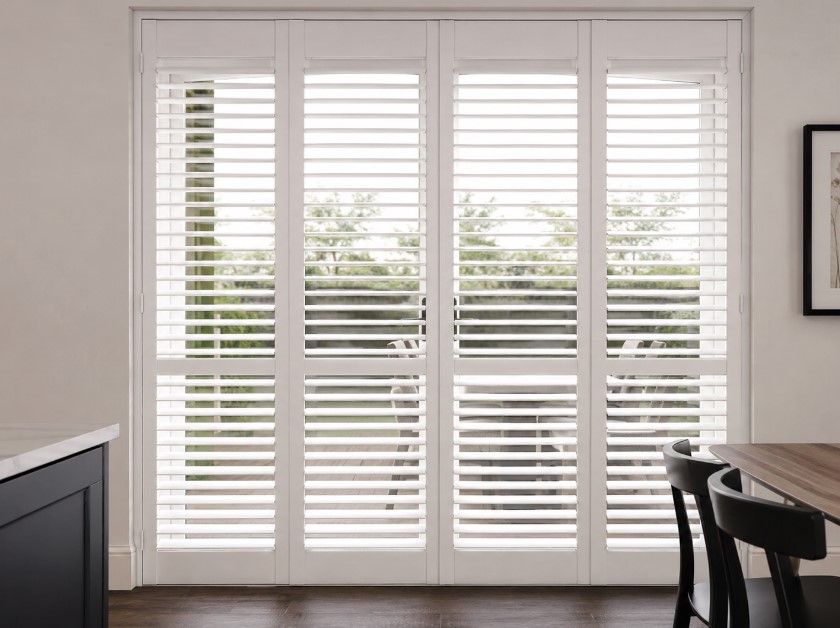
Full height shutters run floor to ceiling in a single panel or series of panels. They give a clean, uninterrupted look and offer excellent light control and privacy. For French doors, pairs of hinged panels that mirror the door itself are a classic and elegant solution.
The key practical consideration here is handle clearances. Your door handle and locking mechanism sit somewhere in the middle of the frame, and the shutter panels need to account for that — either through a cut-out, an offset hinge, or a slight recess. This is exactly the sort of detail that gets sorted at survey stage, not guessed at.
Tier-on-tier shutters for flexible light and privacy
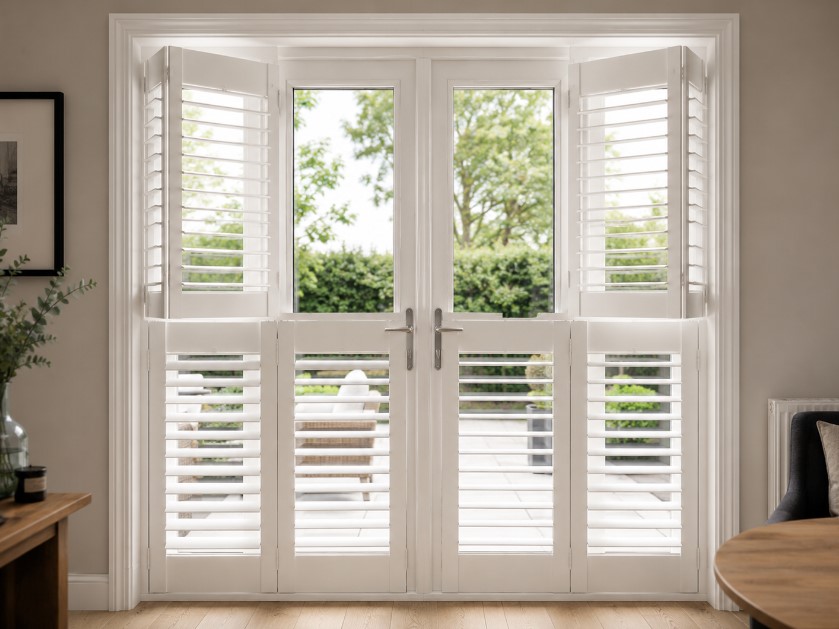
Tier-on-tier shutters split the panel into two independent halves — top and bottom — that open and close separately. This is particularly useful for doors and tall windows where you want light from the top half while keeping the lower half closed for privacy. The classic “neighbours don’t need your life story” setup.
They’re slightly more complex mechanically, but the flexibility they offer is hard to match with any other window treatment.
Café style (when it suits, when it doesn’t)
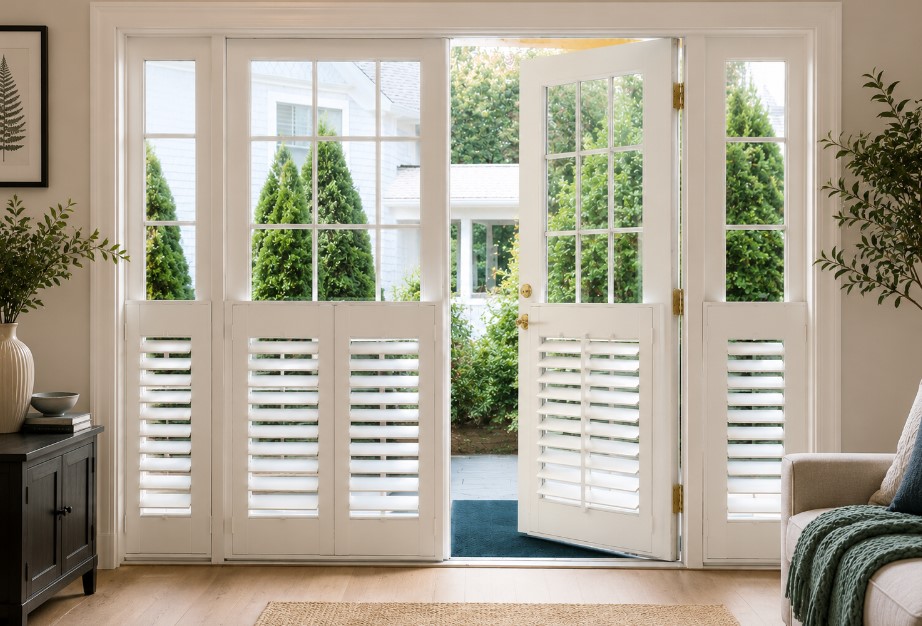
Café style shutters cover only the lower portion of a window or glazed panel — the bit where passers-by or neighbours would otherwise have a clear view in. They’re popular on street-facing windows, but on a patio door they’re less commonly used, since they leave a large upper section of glass uncovered. Fine if privacy isn’t a big concern; less ideal if you want full light control at night.
Solid vs louvred panels
Louvred panels are the most popular choice for doors because they give you adjustable light control without fully blocking the opening. You can angle the louvres to let in diffused light while maintaining privacy, or open them fully for a clear view through to the garden.
Solid panels are occasionally used for a more contemporary look, but they’re essentially blackout when closed — not always what you want on a south-facing opening.
Track system shutters explained
For very wide openings — think large sliding patio doors, floor-to-ceiling glazed walls, or openings that span more than two metres — track system shutters are often the most practical and elegant solution.
In plain terms, track system shutters are plantation shutters mounted on a sliding or bifold track system rather than fixed hinges. The panels glide or fold along a top (and sometimes bottom) track, stacking neatly to one or both sides of the opening when you want access.
Why does this matter? A few reasons:
- No swing space needed. With hinged panels, you need floor clearance for the sweep of the shutter. Track shutters eliminate that.
- Smooth daily operation. If you’re heading in and out to the garden ten times on a sunny afternoon, a well-fitted track system moves with very little effort.
- Cleaner look for wide spans. Multiple sliding panels maintain a consistent, aligned appearance that hinged panels on a very wide frame sometimes can’t match.
- Practical for families. If you’ve got children, dogs, or just a busy household with constant garden access, tracks make everything smoother — literally.
Floor track vs top track is worth a quick mention. Top-track-only systems are tidier underfoot (no threshold to trip over), but for heavier or taller panels, a combined floor and top track gives better stability. This is another detail our team will assess during a survey, taking into account your floor type, door threshold, and how the panels need to operate.
Shutters for large windows: styles that don’t look clunky
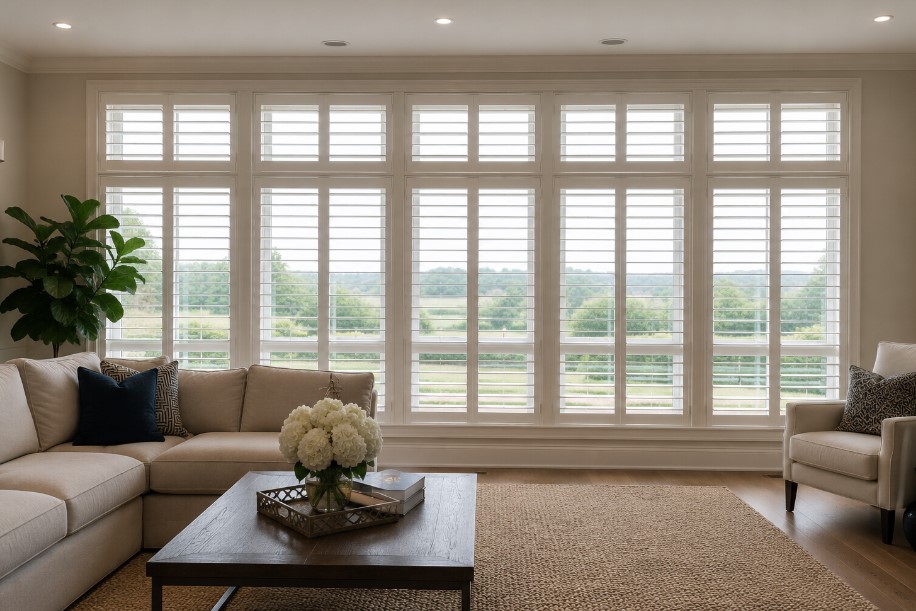
Shutters for large windows present a slightly different set of challenges to doors. The issue here isn’t usually access — it’s proportion, stability, and making sure the finished result looks deliberate rather than awkward.
Tall windows — those floor-to-ceiling glazed panels or full-height feature windows — often benefit from a mid-rail. This is a horizontal dividing bar at roughly eye level that splits the shutter into upper and lower halves. It adds rigidity to the panel, prevents the louvres from bowing under their own weight over time, and — if you go for tier-on-tier — gives you that independent top/bottom operation. A well-placed mid-rail also tends to look more proportionate on a very tall window.
Wide windows — particularly those spanning an entire wall — need careful consideration of how many panels to use and how they divide. Symmetry matters here. An odd number of panels on a wide opening can look unbalanced, and if the proportions of individual panels are too narrow or too wide, the overall result can feel off. Getting this right is genuinely something our surveyors think about during every consultation.
Awkward locations, like stair and landing feature windows, are another area where made-to-measure shutters outperform every off-the-shelf alternative. We’ve fitted shutters on shaped windows, split-level openings, and tight stairwell installations where other solutions simply didn’t work. It’s the kind of job that rewards proper planning and carpentry experience.
Patio doors vs bifolds vs French doors: choosing the right solution
Not all glazed doors are the same, and the shutter solution that works brilliantly on one type can be awkward on another.
French doors — two hinged panels opening inward or outward — are perhaps the most shutter-friendly door type. A pair of full-height hinged shutter panels that follow the door’s own movement is a natural fit, and handle clearances are usually straightforward to plan for.
Sliding patio doors — where one or both panels slide horizontally — are where track system shutters really come into their own. A hinged panel would obstruct the door’s movement; a tracked shutter system moves in harmony with it.
Bifold doors — which fold and stack to one side — are the most variable. Whether shutters work well depends largely on how much stacking space is available and how often the doors are fully opened. For bifolds that are regularly opened right back, a tracked or sliding shutter system that can be parked to one side is typically the most practical option. If they’re used more as a feature than a frequently opened door, hinged panels can work well. As with most things here, the right answer comes out of a proper survey.
Design choices that matter more than people think
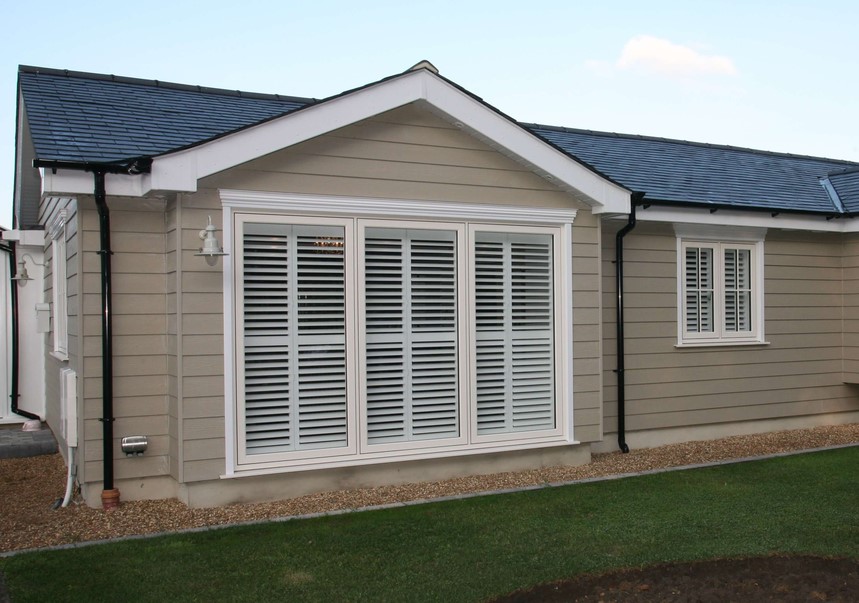
Once you’ve settled on the style and configuration, there are a handful of design details worth thinking about.
Louvre size affects how the finished shutter looks and how much light comes through. Larger louvres (89mm or 114mm) tend to work better on big openings — they’re in better proportion and let in more light when open. Smaller louvres can look fussy on a wide frame.
Colour is perhaps the most personal choice. Classic white and off-white remain the most popular options for good reason — they’re timeless, they reflect light well, and they suit almost every interior. That said, we can colour match to virtually any shade, including the Farrow & Ball palette if you’re mid-renovation and want everything to tie together. It’s a small detail that makes a big difference.
Privacy angles are worth a moment’s thought. Shutters give you fine-grained control — louvres angled upward let light in from the sky while blocking the sightlines from the garden or street. It’s a small adjustment that most people come to appreciate after their first week of having shutters fitted.
Thermal and UV benefits are a genuine bonus on large glazed openings. Shutters act as an additional layer of insulation — useful in winter — and the louvres can be angled to diffuse direct sunlight in summer, protecting flooring and furniture from UV fading.
Measuring and fitting considerations (why a proper survey helps)
This section might seem obvious, but it’s worth spelling out, because it’s where a lot of DIY or poorly-specified shutter jobs fall apart.
Made-to-measure shutters for patio doors and large windows aren’t a product you size off a tape measure on a Saturday afternoon. There are recess depths, frame conditions, architrave and skirting profiles, door hardware positions, alarm sensors, floor thresholds, and structural considerations that all affect how the shutter is specified and fitted.
Our process is straightforward. A member of our team visits your home for a free, no obligation design and survey appointment. We go through everything with you, take precise measurements, and talk through the options — styles, configurations, louvre sizes, colours. The result is an accurate, honest quote with no hidden extras.
All our installations are carried out by our own fully trained fitters — people who’ve spent years working with both shutters and carpentry. We don’t use subcontractors. That matters, because the quality of a shutter installation is only as good as the care taken at every stage, from the frame prep to the final adjustment of the louvres.
Shutters vs blinds for patio doors and big windows
This is a question we’re asked regularly, so it’s worth a direct answer.
Shutters are more durable, require less maintenance, and — once fitted — are a permanent, integral part of the room. They add value to a property, provide better thermal insulation, and offer a level of light control and privacy that most blind systems can’t match. They’re also, frankly, just better-looking on a large opening.
Blinds are typically less expensive upfront and offer more flexibility — you can change them without affecting the room’s structure. For some applications, particularly where a very large opening needs to be covered but the budget doesn’t stretch to a full shutter installation, blinds are a perfectly sensible choice.
We supply both — so if shutters aren’t the right fit for your project, we’re not going to push them. Our team will give you an honest recommendation based on what works for your specific window or door.
Care and maintenance: keeping them looking smart
One of the more underappreciated benefits of plantation shutters is how little upkeep they need. A regular dust with a soft cloth or a brush attachment on the vacuum keeps the louvres clean. For a deeper clean, a slightly damp cloth works well — just avoid soaking the wood, particularly near joints and hinges.
What to avoid: harsh chemical cleaners, abrasive cloths, and steam cleaners near the frame or louvres. The painted or stained finish on good-quality shutters is durable, but it’s not indestructible.
Day to day, shutters are as robust as any other fitted interior joinery — which is part of what makes them such good value over time.
FAQs
Can you fit shutters on sliding patio doors?
Yes — and they often look best with track system shutters, which are designed to slide or fold along a track rather than swing on hinges. This keeps the door’s movement unobstructed and makes daily use smooth and easy.
Do shutters get in the way of door handles?
Not when they’re designed correctly. Handle cut-outs and clearances are planned during the survey stage, so the finished shutter accommodates your door furniture properly.
Are door shutters UK-fitted shutters secure?
Shutters add a meaningful layer of privacy and a “perceived security” effect — someone looking at a closed shutter panel can’t see whether the room is occupied. They’re not a substitute for proper door locks, but they do add a visual deterrent.
Will shutters block too much light on large windows?
Not if the louvres are set correctly. Angled louvres let in diffused light while maintaining privacy. Tier-on-tier configurations give you even more flexibility, letting you open the top half for light while keeping the lower half closed.
What’s the best style for bifold doors?
It depends on how the doors stack and how regularly they’re fully opened. Track system shutters are often the most practical option for bifolds that are used frequently. A survey is genuinely the best way to assess which configuration suits your specific setup.
Do I need a track system for wide openings?
Not always, but for openings wider than around 1.8–2m, or for sliding door configurations, a track system is usually the most practical and visually tidy solution.
Are shutters hard to clean on big windows?
No — they’re one of the lower-maintenance window treatments available. A periodic dust and occasional wipe-down is all they need.
How much do shutters for patio doors cost in the UK?
The price depends on the size of the opening, the style chosen, the material, whether a track system is needed, and the colour or finish. The most straightforward way to get an accurate figure is to book a free survey — we’ll give you a full, itemised quote with no hidden extras.
How long does it take from survey to fitting?
Lead times vary depending on the specification and current order schedules. We’ll give you a realistic timeline at the survey stage.
Ready to get it right first time?
Shutters for patio doors and large windows are one of those investments that genuinely transforms how a room feels — better light control, more privacy, less noise, and a finished look that nothing else quite matches. But they’re also the kind of job where the details matter, and where a proper survey makes the difference between a perfect installation and a frustrating one.
We’re a small, independent family-run business based in Chelmsford, covering Essex and surrounding areas — and we fit every job with our own fully trained installers. No subcontractors, no guesswork.
If you’d like to explore what shutters could do for your patio doors or large windows, we’d love to come and take a look. Our design and survey appointments are completely free and carry no obligation.