
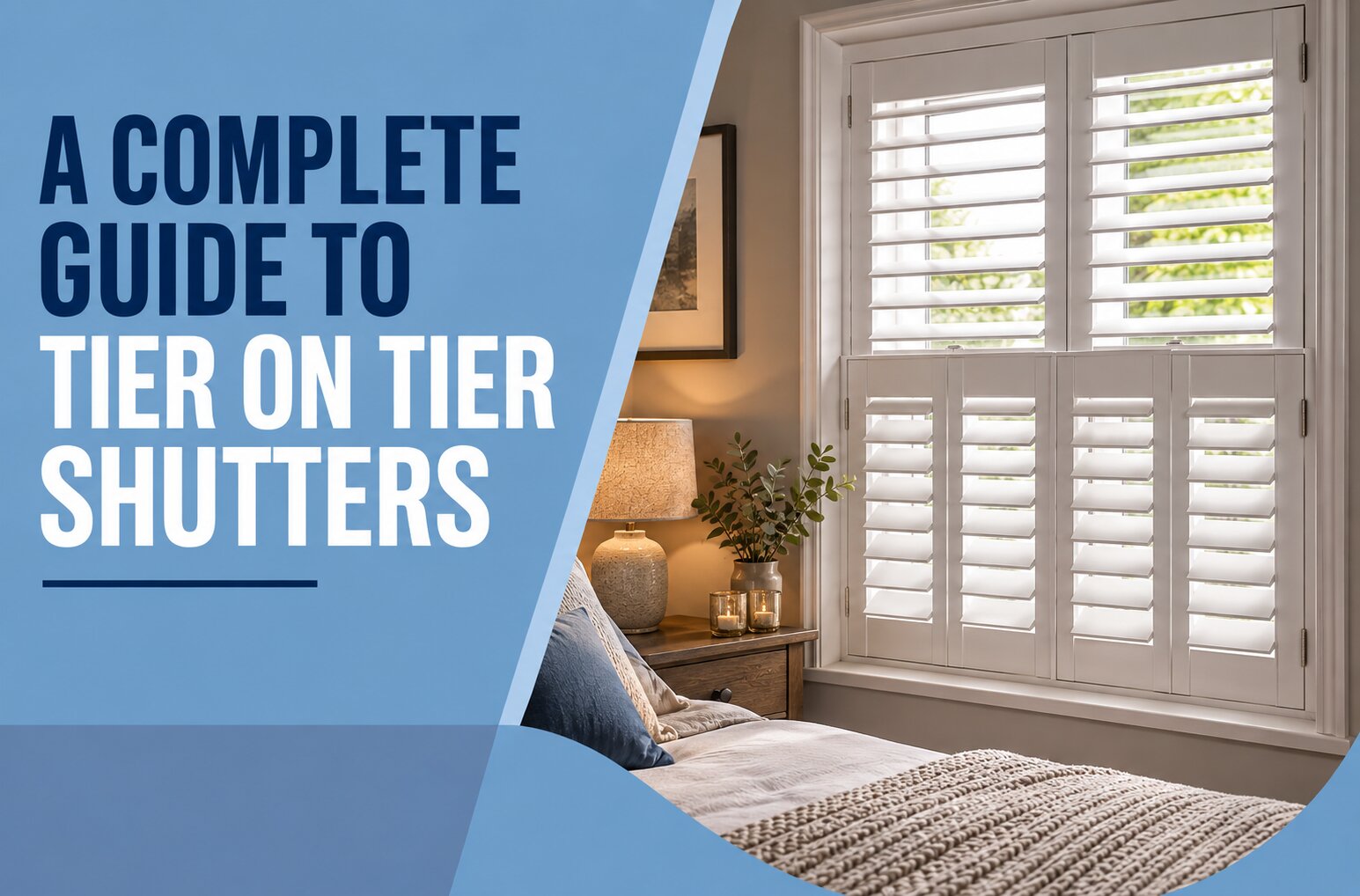

Tier-on-tier shutters feature two independent sets of shutter panels stacked vertically on the same window. Because the top and bottom tiers operate separately, you can keep the bottom closed for privacy while the top lets in natural light — or vice versa. They’re the most versatile plantation shutter style available, and they work particularly well in street-facing rooms, bay windows, and bedrooms.
There’s a very specific frustration that comes with living on a busy road or being slightly too close to a neighbour’s window. You want the light. You absolutely need the light. But you’d also rather not have passing strangers peering in while you’re eating your breakfast in your dressing gown. Standard curtains block light the moment you close them. Roller blinds offer a similar all-or-nothing trade-off.
Tier-on-tier shutters solve this rather neatly. They give you full coverage of the window — without forcing you to choose between daylight and privacy. Here, we’ll break down exactly how they work, what makes them different to café-style shutters, which rooms they suit best, and what to look for before buying.
What are tier-on-tier shutters?
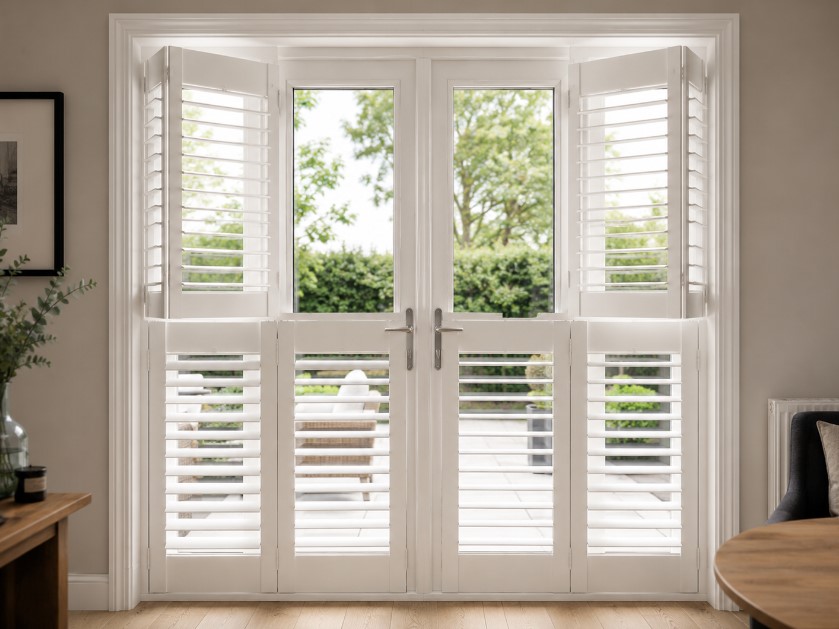
Tier-on-tier shutters are a style of plantation shutter where two separate panels are hung one above the other — each with their own set of louvres (the adjustable slats) and their own hinges.
The key thing that makes them special is independence. The top panel and the bottom panel are entirely separate. You can fold the top tier back to let in full daylight while keeping the bottom tier closed for privacy. You can tilt the louvres on just one section. You can close both completely. Or open both for an unobstructed view.
In plain terms: you’re not stuck with one setting. You can adapt throughout the day depending on the light, what you’re doing in the room, and whether the postman is standing on your doorstep.
Why homeowners love them (and when they’re not the best fit)
Tier on tier shutters benefits
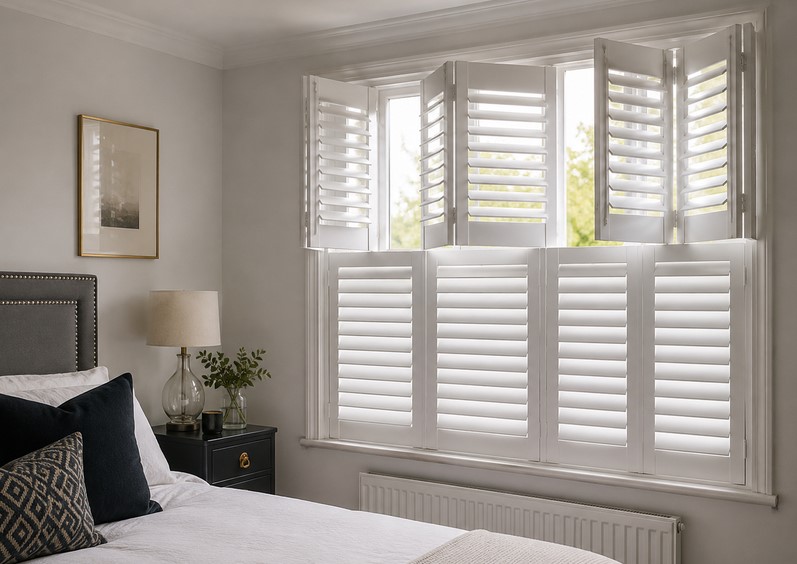
The headline benefit is privacy without darkness — and it’s genuinely useful in daily life. Keep the bottom tier closed against street level and open the top for natural light to flood in. As a bonus, if you angle the louvres correctly on the closed tier, you can actually see out while nobody outside can see in.
Beyond privacy, tier-on-tier shutters offer:
- Flexible light and glare control — adjust each tier independently to manage direct sun at different times of day
- Better ventilation — open the top tier, crack a window, and let air move freely without sacrificing privacy
- Extra thermal insulation — when both tiers are closed, they act as an additional layer between your room and the cold glass, which helps with energy costs during winter
- Sound reduction — closed shutters do a decent job of dampening external noise, especially useful on busy roads
- Low maintenance — no fabric to wash, no dust mites to worry about; a quick wipe-down is all they need
- Kerb appeal — they look smart from outside too, which is a genuine bonus for property value
Potential drawbacks to know upfront
Being balanced is important here. Tier-on-tier shutters are typically more expensive than single-panel styles like full-height or café-style shutters. There are more components involved — double the hinges, double the panels, more precision required in both manufacturing and installation. That cost is usually well justified, but it’s worth knowing in advance.
You’ll also notice more panel lines on the window face compared to a clean full-height design. For most people, that’s a styling preference rather than a problem. And if you know you’ll almost always keep shutters fully open or fully closed, you may not actually need the added flexibility — in which case a full-height shutter with a mid-rail could be worth comparing.
Tier on tier shutters vs café-style shutters
This is one of the most common comparisons people make when researching shutters, so it’s worth being direct about the differences.
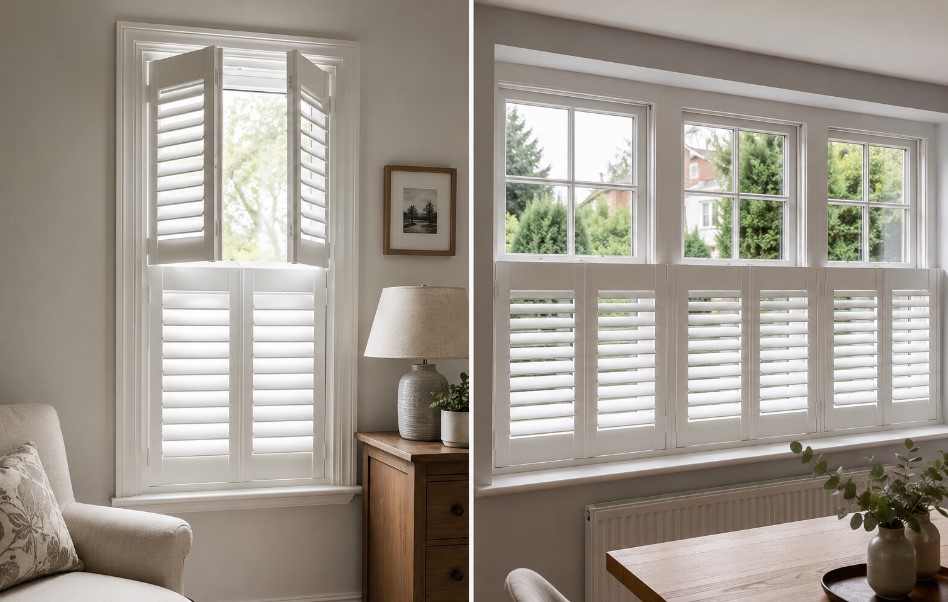
Café-style shutters cover only the lower half of the window. The top half is completely open — no frame, no panel, just glass. They’re a classic look, great for maximising daylight, and particularly popular in kitchen and living room settings facing onto a street.
Tier-on-tier shutters cover the full window height, but with independent top and bottom panels. The result is full flexibility rather than a fixed half-and-half setup.
Here’s a simple way to decide:
Choose café-style if:
- You want maximum daylight all day, every day
- Privacy at the lower half is enough for your situation
- You prefer a lighter, more continental aesthetic
- Budget is a consideration
Choose tier-on-tier if:
- You want full coverage with the option to vary light and privacy throughout the day
- Your room is street-facing or overlooked from multiple angles
- You want the flexibility to open or fold back either tier independently
- You’d like a more complete, polished look across the whole window
The short version: café-style is great for constant daylight with baseline privacy. Tier-on-tier is better when your needs genuinely change throughout the day.
Which rooms are tier on tier shutters best for?
Which rooms are tier on tier shutters best for? The honest answer is that they suit most rooms — but there are a few where they really earn their keep.
Living rooms and front reception rooms are probably the most popular application. Street-facing windows are exactly where you want the ability to let in light while keeping the lower half private from anyone walking past.
Bedrooms benefit enormously too. In the morning, you might open the top tier for gentle natural light while keeping the bottom closed. At night, you close both for complete darkness and privacy. It’s a level of control that a standard blind simply can’t match.
Bathrooms work well with tier-on-tier shutters, particularly when using a moisture-resistant material (our Hollywood range, for instance, is designed for exactly these environments). You can keep the top open for ventilation and natural light while the bottom remains closed — sensible in any bathroom, especially a ground-floor one.
Home offices are another strong fit. Tier-on-tier shutters help reduce screen glare from direct sun on the top panes while keeping your workspace well-lit. Useful, and considerably better than squinting at your monitor all afternoon.
Bay windows are a natural pairing. Made-to-measure tier-on-tier shutters can be tailored to fit the angles of a bay beautifully, and the independent tiers work particularly well in these wider window configurations.
Design options that make tier-on-tier work even harder
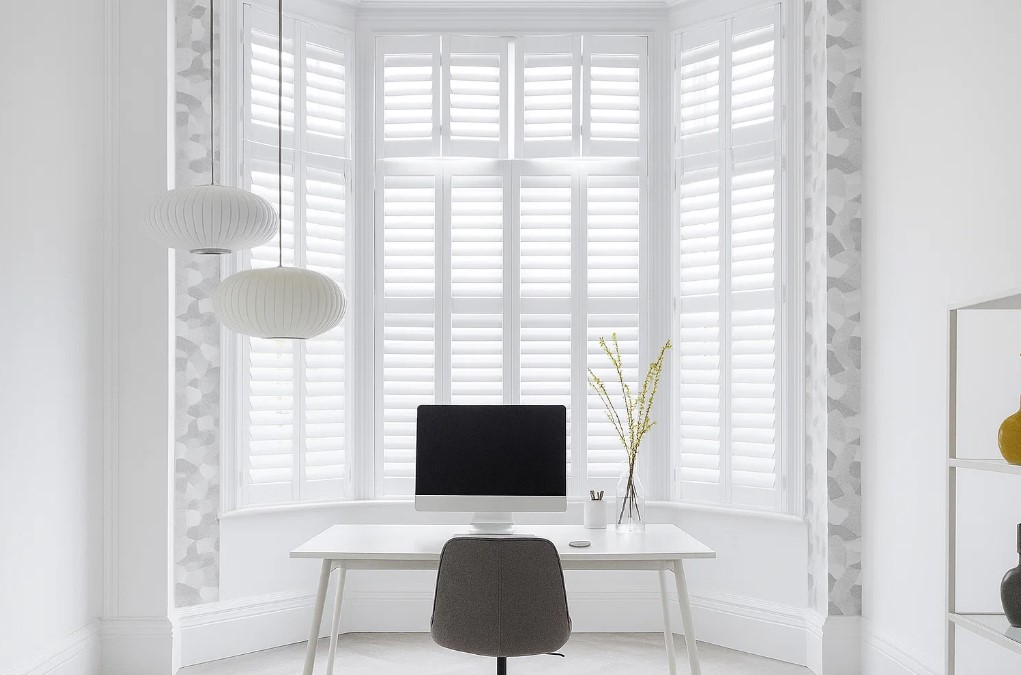
The good news is that tier-on-tier shutters aren’t just functional — they’re genuinely customisable to your interior.
Louvre size is the first thing to consider. Larger louvres (89mm or 114mm) give a more contemporary feel and let in more light when open. Smaller louvres (47mm or 63mm) suit traditional or period properties well and offer finer light control.
For colour, white remains the most popular choice and works with virtually any interior — from modern minimalist to classic Georgian. We offer a full colour-matching service, including the most popular Farrow & Ball shades, so your shutters can be matched precisely to your existing décor rather than just approximated.
For a more natural look, several of our ranges are available in wood stains that bring out the grain of the timber. The Carolina range, made from FSC-certified White Teak, is available in both paint and stain finishes and suits almost any window shape or size.
You can also pair tier-on-tier shutters with curtains or voiles if you want soft furnishings in the room — the shutters handle the practical work, and the fabric adds warmth and texture.
Practical buying tips before you commit
Think about your daily routine, not just the room. When does the sun hit that window? When are people most likely to be walking past? Answering these questions helps you decide whether tier-on-tier is genuinely worth it over a simpler option.
Get a professional survey done. Made-to-measure shutters are only as good as the measurements they’re made from. Windows are rarely perfectly square, and even minor sizing errors can cause gaps, misalignment, or panels that don’t sit flush. A professional survey eliminates guesswork.
Pay attention to the finish around the frame. One of the things that separates a great installation from a mediocre one is the detailing — colour-coordinated trims, extended window nosing, neat lines where the frame meets the wall. This matters more than most people realise when the shutters are actually on the window.
Why made-to-measure and proper installation matter more than people think
It’s tempting to focus entirely on the product specification — the material, the louvre size, the colour — but the installation is just as important.
Tier-on-tier shutters involve more components and more alignment considerations than a basic full-height panel. Both tiers need to open and close smoothly, the hinges need to be set correctly, and the whole thing needs to sit level within the frame. Done well, it’s seamless. Done poorly, you’ll notice the imperfections every time you use them.
We use our own fully trained carpenters for every installation — no subcontractors, ever. Every fitter arrives in a Lifestyle van, every job is measured and fitted by someone with real shutter experience, and every installation is finished with the kind of attention to detail that makes a genuine difference to the final result.
Frequently asked questions
Are tier-on-tier shutters good for privacy?
Yes — they’re one of the best shutter styles for privacy. You can keep the bottom tier closed to block visibility from the street while the top tier lets in natural light. Angled louvres on the closed tier mean you can see out without anyone being able to see in.
Do tier-on-tier shutters provide good natural light control?
When both tiers are fully closed with the louvres shut, they block out the majority of light. They won’t achieve the total blackout of a solid panel, but they’re excellent for general light control. For a bedroom requiring complete darkness, pairing them with a blackout blind behind the shutter is an option worth considering.
Are tier-on-tier shutters more expensive than full-height shutters?
Generally, yes. Because there are two independent sets of panels and frames, more material and labour is involved. The additional cost is usually offset by the flexibility you gain — but if you don’t need independent top-and-bottom operation, a full-height shutter with a mid-rail might offer similar benefits at a slightly lower price point.
What’s the difference between tier-on-tier and cafe-style shutters?
Café-style shutters cover only the bottom half of the window, with the top left completely open. Tier-on-tier shutters cover the full window in two separate panels that operate independently. Café-style is ideal if you always want daylight from the top. Tier-on-tier is better when you want to vary light and privacy across the whole window.
Which rooms suit tier-on-tier shutters best?
They work particularly well in street-facing living rooms, bedrooms, bathrooms, home offices, and bay windows. Essentially, any room where your privacy or light needs change throughout the day.
Are tier-on-tier shutters suitable for bay windows?
Absolutely. Made-to-measure tier-on-tier shutters can be built to fit the angles and dimensions of a bay window precisely, and the independent tiers are well-suited to the wider window spans commonly found in bay configurations.
Are shutters hard to clean and maintain?
Not at all — it’s one of the reasons many people choose them over curtains. A wipe-down with a damp cloth is usually enough. Unlike fabric window dressings, shutters don’t harbour dust mites and don’t need washing.
Can shutters be matched to my wall colour or décor?
Yes. We offer a colour-matching service that covers virtually any shade, including the most popular Farrow & Ball colours. Whether you want a classic white, a warm off-white, or something bolder, we can match your shutters to your interior.
How long does it take from survey to installation?
In many cases, we can have shutters fitted within two weeks. Timings can vary depending on the specification and volume of the order, so we’d recommend getting in touch to discuss your specific requirements — we’ll give you an honest timeline from the start.
Ready to get your perfect shutters?
If tier-on-tier shutters sound like the right fit for your home, the best next step is a free, no-obligation design and survey appointment. One of our team will visit you at a convenient time, take accurate measurements, walk you through the options, and give you an honest quote — no hard sell, no hidden extras.
We’re a small, independent family-run business based in Chelmsford, covering Essex and the surrounding areas including Kent and London. Every installation is carried out by our own fully trained carpenters, so you get consistent quality from survey to fitting.
Book your free survey or browse our shutters gallery to see the kind of work we do. You’re also welcome to give us a ring — we’re always happy to talk shutters.